
Men’s Skincare – Choosing the Right Stuff

men skincare

The attention paid to men’s health has certainly evolved over the last few decades. We have evolved from a time when men would rarely talk about (much less have) daily skincare regimens to today when industry research shows that men are spending as much money on skincare as women. Men are spending just as much money as women on skincare products, with male skincare products being the fastest-growing segment of the men’s grooming industry. With so many products, it’s easy to be overwhelmed by the sheer quantity of products available. So what is really necessary for the well-groomed man to have in his bathroom?

Healthy skin is a vital part of a person’s appearance. If your skin isn’t cared for properly, it can make you look older or unhealthy. There are many products to help men to maintain their skin including moisturizers, facial cleanser, anti-aging creams, body wash, and much more. How do you know which ones to choose, or even what you need? Here are a few things to keep in mind when selecting skincare products. 

1. Avoid products with heavy scents. While smelling good is something that everyone enjoys, many scents can easily be overpowering, particularly artificial scents. Products that have artificial scents can irritate your skin, as the additives used to create the scents are typically a combination of harsh chemicals. Stick with light or natural scents. In addition to avoiding possible rashes and breakouts, your coworkers will appreciate it.

2. When applying products, less is more. Some people think that in order for a skincare product to be effective, it must be layered on like paint on a bare wall. Most of the time, this is not the case. Moisturizers should be rubbed into the skin so that the skin is moistened but not wet. Many facial cleansers require only an amount the size of a nickel or quarter to be effective. In addition to being wasteful, the excessive product can clog your pores, causing breakouts or even cause infection. 

3. Go natural. Generally speaking, you want to stay as natural as possible with your skincare. Anti-acne products, for example, tend to use harsh chemicals such as benzoyl peroxide or salicylic acid. These chemicals have been known to cause chemical burns and allergic reactions, leaving permanent scars. Try and find options with fewer chemicals and that use overly artificial additives. 

4. Don’t be afraid to ask for advice. Men have particular needs when it comes to skincare, just as women do, and the variations between needs can be vast. What works for women’s skin may not work for yours so it’s important to pay attention to what your specific needs are. If you spend a lot of time outdoors, for instance, you’ll want to find products that contain a minimum of 50 SPF. If your skin tends towards dryness, then a good moisturizer is going to be a cornerstone product in your repertoire. Do you break out constantly? Then products for sensitive skin might be the best choice for you. Ask your doctor what they recommend and if you need to, see a dermatologist for persistent issues.

Skincare doesn’t need to be complicated. In fact, it’s best to keep things simple. Finding the right products might take a little time but in the end, the effort will be worth it. For many men, having a healthy, virile appearance is a key part of their psyche and self-worth. Learning what skincare products work best for you is the first step in this process.
The Everyday Dangers of Using Harsh Chemicals On Your Skin

Most of us want beautiful, fresh, blemish free skin. After all, our skin (especially on our faces) is one of the first things you notice about a person. Therefore, it is no wonder that the average woman spends $15,000 on beauty products in her lifetime!

Of course, this is why many of us reach for bottled lotions and potions, be it to eliminate enlarged pores or fill in wrinkles – but if you’re an acne sufferer, you’re even more likely to reach for anything that claims to alleviate the issue.

The problem is, the beauty products we find on our shelves today are highly unregulated. There are thousands of chemicals in everyday beauty products and what is important to remember is that many of these are absorbed by your skin and enter your bloodstream. That’s why just in the same way you would check food packaging to ensure what you’re putting into your body is safe, the same should be considered with beauty products.

Are There Really Harsh Chemicals in Beauty Products?

Yes. Currently the regulations regarding beauty products are minimal. Some of the most common chemicals have been shown to have serious long term negative health effects including promoting the development of different kinds of cancer.

Let’s take a look at just some of the most common chemicals and their potential dangers.

Parabens

Parabens are preservatives that are widely used in cosmetic products as they prevent the growth of bacteria. You may have heard of parabens before as nowadays, many plastic drinkware companies advertise their products as “paraben free”.

The reason many companies are quick to boast about the lack of parabens in their products is because studies have shown them to be linked to an increased risk of breast cancer, due to their estrogen-mimicking abilities (source). Parabens have even been identified in breast tumor biopsy samples.

Fragrance

Fragrance is a pretty vague term – I mean, what is a fragrance anyway? The truth is, that fragrance concoctions can be responsible for extreme allergic reactions and dermatitis according to the EWC Deep Skin Database (source).

Originally, the term fragrance was coined as a way to prevent companies from giving away their “secret ingredient” that gave their product that special je ne sais quoi. However in reality, it has enabled companies to concoct a blend of potentially harmful toxins and not have to state it on the label.

Synthetic Colors

Certain types of synthetic colors are actually made from coal tar and petroleum (source) and current scientific research suspects them to be a human carcinogen (source).

You will note synthetic colors listed on the back of product labels as D&C red 1 or FD&C Green 26 for example. These food (F), drug (D) and cosmetics (C) colors have been shown to not only irritate skin but also show links to ADHD in children (source).

FD&C and D&C colors are considered so dangerous in some parts of the world that the European Union has actually banned their use (source).

How to Avoid Using Harsh Chemicals on Your Skin

Of course, the above chemicals are only the top three of a very long list you will find in everyday skincare products throughout your home. It is obviously impossible to avoid all the synthetic chemicals out there as they are in everything we use from deodorant to sunscreen, but you can do your best to limit how many toxic chemicals your body is exposed to, especially if you have sensitive skin.

Ideally, everyone should try to remove these kinds of products from their skincare regime, but those with skin issues like acne or with allergies should definitely leave these products by the wayside.

The best way to avoid using harsh chemicals is to choose products that are organic and natural. With everyday, well known, natural ingredients such as herbs and probiotics. Also, aim for products clearly advertised as “100% natural” and “chemical free / fragrance free”.

Moreover, look for certifications from the governing bodies like the FDA or labels like “certified organic”.  This will help to ensure anything you put on your skin will not have any kind of adverse effects.

Conclusion

In order to stay safe with beauty products and prevent the everyday dangers of using harsh chemicals on your skin, try doing your research about products before purchasing them, especially when buying online. Also, make checking your beauty product labels a habit.

Educate yourself in order to recognize the ingredients to beware of to help you and your family stay safe.

Helen Sanders is chief editor at HealthAmbition.com. Established in 2012, Health Ambition has grown rapidly in recent years. Our goal is to provide easy-to-understand health and nutrition advice that makes a real impact. We pride ourselves on making sure our actionable advice can be followed by regular people with busy lives.

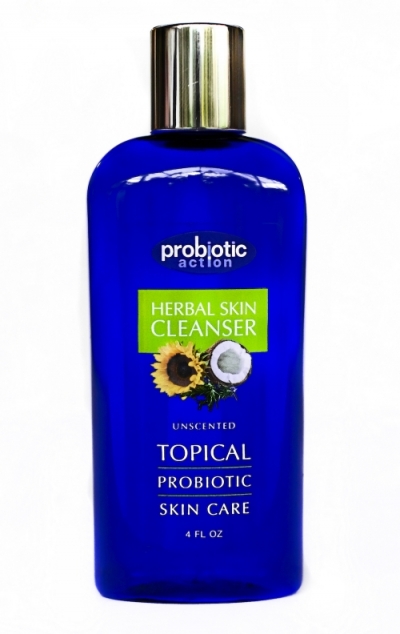
Our Herbal Probiotic Cleanser Is Here & It’s Awesome

Over the past several years, Probiotic Action has received requests for an all-natural probiotic facial cleanser.

Well, we have good news. After two years of research, it’s finally here. We’re introducing our Probiotic Herbal Cleanser.

Our Herbal Cleanser was designed to rebalance the skin bacteria and gently pull excess dirt and debris from pores to safely clean and nourish the skin.

Daily use of our probiotic cleanser helps maintain a strong immune system in the skin by cultivating a healthy microbiome. Here’s why we’re so excited about our new Herbal Cleanser:

A gentle cleansing gel for all skin types

Great skincare starts with great ingredients.

Our Herbal Cleanser is all natural, containing stable and recognizable ingredients that help condition the skin and re-introduce beneficial bacteria to irritated tissue.

Here’s what’s inside Probiotic Action’s 100% chemical-free Herbal Cleanser and why it works:

  1. Bacillus bacteria 

    Probiotic Action products contain Bacillus subtilis, an organism we like to refer to as “The Good Bacteria.”  Bacillus subtilis is found naturally in soil and on vegetation. It’s also present in the human intestinal tract as well as on the skin. Probiotic Action’s Herbal Cleanser contains Bacillus spores that activate when they come in contact with water. The Bacillus bacteria works by out-competing the primary bacteria that becomes imbalanced with skin conditions like acne and rosacea. With acne, the primary bacterial culprit is Propionibacterium acnes. Bacillus competes with P. acnes by taking its food source. Research also suggests that Bacillus subtilis competes with some strains of harmful bacteria by secreting chemical compounds that prevent other bacteria from flourishing.

     
    1. Sunflower oil

      Sunflower oil contains high levels of linoleic acid, which is an essential fatty acid with antimicrobial properties, priming the skin for probiotic application. Laboratory tests have found that sunflower oil contains up to  72 percent of the compound. Sunflower oil is also high in vitamin E, with one tbsp containing about 1.8 mg of the vitamin. Vitamin E is a fat-soluble antioxidant that protects skin from environmental damage.


  1. Coconut oil

    Coconut oil contains lauric acid, which is a natural antimicrobial. In fact, research has shown that lauric acid reduces bacteria on the skin 15 times better than the chemical benzoyl peroxide, a common addition to treatments for acne and rosacea. Coconut oil contains around 45 percent of lauric acid, making it one of the best dietary sources. This fat is an excellent carrier oil for the rosemary extract Probiotic Action’s Herbal Cleanser contains, delivering fat-soluble nutrients deep into the skin.
  2. Rosemary extract

    Rosemary essential oil is extremely beneficial for the skin and hair. Interestingly, it’s signature scent is what makes the extract so helpful. Rosemary contains a variety of different terpenes, which are aroma molecules that give the plant its fragrance. One of the most dominant terpenes is ɑ-pinene, which is also found in pine needles. This terpene has been shown to reduce oil build-up in the skin.
    It does this by reducing the size of the glands that are over-producing the oil. Rosemary extract also has antimicrobial properties, preparing the skin for the application of beneficial probiotics.How to save money on Probiotic Action

    Wondering if our Herbal Cleanser is right for you? The only way to find out is to give it a try. For a limited time only, Probiotic Action’s Herbal Cleanser is available for $5.85 on Amazon

    Our Herbal Skin Cleanser is vegan, all natural, and completely chemical and fragrance free. A soothing gel, this cleanser is safe for all skin types and delivers a powerful topical probiotic with each wash. Have you already tried it?

    We’d love a review! We encourage you to leave a review on Amazon and let us know how the product worked for you.

    Most customers will see the first signs of improvement after one week of continuous use.